

Patents are effective mechanisms for encouraging and safeguarding innovation. They give innovators exclusive rights to their work, allowing them to profit from their hard work. These exclusive rights, however, do not last forever. Understanding a patent’s lifespan is essential for businesses and inventors who want to make the most of their intellectual property. We shall examine the nuances of patent duration in this essay and its importance and effects on the innovation scene.
The Duration of Different Types of Patents:
1. Utility patents
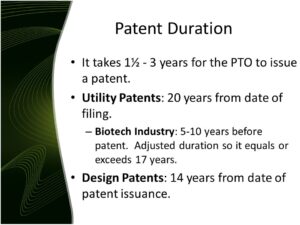
The most popular kind of patents are usually granted for inventions with practical use. A utility patent has a 20-year life span starting from the date of filing in the majority of nations. It’s crucial to remember that this 20-year period could change or be adjusted in accordance with regional laws and international agreements.
2. Design patents:
These patents guard a manufactured object’s decorative look. Each nation has a different time limit for design patents. The duration is 15 years starting on the date of grant, for instance, in the United States.
3. Plant Patents:
Plant patents protect newly developed, unique plant varieties produced by asexual reproduction. A plant patent has a 20-year lifespan starting from the date of filing.
Significance of Patent Duration:
The lifespan of a patent affects innovators, companies, and the entire innovation ecosystem in a number of ways:
1. Time to Recoup Investments:
Time to Recoup Investments With the exclusivity a patent grants, businesses, and inventors can recover their R&D and marketing expenditures. The more time they have to capitalise on their innovation, the longer the period.
2. Encouragement for Innovation:
The short lifespan of patents inspires innovators to keep coming up with new ideas. Inventors are motivated to develop novel and enhanced solutions as patents approach expiration in order to remain competitive.
3. Balancing Interests:
The amount of time that a patent is valid achieves a compromise between compensating inventors and enabling society to use the knowledge and technology after the patent has expired. It encourages innovation and development across a range of businesses.
Managing Patent Duration:
Planning strategically is required to manage the life of patents:
1. Prompt filing is necessary to ensure the greatest term of protection because patents are awarded to the first inventor to file.
2. Maintenance costs:
Many nations impose maintenance costs to keep patents in effect. To keep their patents active, inventors and patent holders must be diligent about paying these fees.
3. Innovation Cycles:
Inventors need to be knowledgeable about the innovation cycles that exist in their sector. They might prepare for new discoveries as their patents get closer to expiration to keep a competitive edge.
Conclusion:
One dynamic element that molds the innovation landscape is the length of patents. It promotes continued innovation while giving innovators a window of exclusivity to profit from their creations. For inventors and companies looking to protect their intellectual property, it is crucial to comprehend the various utility, design, and plant patent periods. Innovators can accelerate development and contribute to the evolution of technology and society by wisely managing patent terms and making the most of the time patents offer.
2. Understanding Design Patent Duration: Safeguarding Aesthetic Innovations:
The distinctive aesthetic and ornamental features of various items are crucially protected by design patents in the dynamic world of intellectual property. These patents give designers and innovators the only right to the visual design components, preventing others from copying their inventions’ distinctive appearances. However, firms and innovators must understand how long a design patent will last to protect their aesthetic inventions.
1. The Duration of Design Patents:
Design patents are solely concerned with the decorative characteristics, as opposed to utility patents, which also cover functional aspects of inventions. The lifespan of a design patent varies from nation to nation, but for now, let’s concentrate on the US situation. A design patent in the US is valid for 15 years from the grant date. During this time, inventors have a large window of protection to make money off of their distinctive visual designs.
2. The Foundation of Design Patents:
Utility patents protect the functional aspects of an innovation, while design patents protect the aesthetic and adornment aspects of an invention. A design patent is intended to stop others from creating, using, or selling goods with a design identical to or strikingly similar to the patented design. This protection promotes creativity and honours artists for their contributions to aesthetics.
3. Duration and Term:
Design patents have a shorter term than utility patents, which normally last 20 years from the date of filing. A design patent in the US offers defence for 15 years after the date of issuance. This time frame makes sure that the creator has sole ownership of the visual design for a sizable amount of time, encouraging innovation and enabling commercial exploitation.
4. Balancing Protection and Innovation:
The relatively short lifespan of design patents reflects a compromise between safeguarding the designs of creators and encouraging innovation. While design patents give artists a brief period of exclusivity, they also acknowledge the necessity of designs eventually entering the public domain so that others might be inspired by them and help shape the development of design trends.
The Role of a Utility Patent Lawyer: Navigating Innovation’s Legal Landscape:
Progress is built on innovation, thus protecting your ground-breaking ideas legally is crucial in today’s cutthroat business environment. A utility patent attorney—a lawyer with expertise in defending your creative thoughts through the complexities of patent law—enters the picture at this point. We examine the crucial function of a utility patent attorney and their essential contribution to the field of invention in this post.
1. Defining Utility Patents and Their Significance:
Utility patents, which provide inventors exclusive rights to their inventions for up to 20 years, are a cornerstone of intellectual property protection. These patents protect novel and beneficial methods, devices, material compositions, and ornamental designs. The protection they offer is crucial for the development of enterprises and economies as well as for the financial success of innovators.
2. Navigating the Complexities of Patent Law:
The field of patent law can be complex, and full of subtle legal distinctions, rules, and demands. A utility patent attorney is a specialist who helps innovators navigate this maze, ensuring that the patent application procedure is simple and the patent that is issued is solid. These solicitors are prepared to handle the technicalities while you concentrate on innovation, from conducting prior art searches to drafting thorough patent applications.
3. Role of a Utility Patent Attorney:
a. Knowledge of Patent Search: A complete search of the prior art is necessary before submitting a patent application. To lay the groundwork for a successful patent application, a utility patent attorney does extensive research into previous patents and publications to make sure your idea is original and not obvious.
b. Strategic Patent Drafting: Care must be used when drafting a patent application. A utility patent attorney can transform intricate technical facts into language that is worthy of a patent, ensuring that your innovation is appropriately identified and safeguarded.
c. Legal Criteria: Patent applications must adhere to stringent legal requirements.
A utility patent attorney makes sure that your application satisfies all criteria, reducing the possibility of rejections or objections in the future.
d. Responding to Office Actions:
If a patent examiner challenges or asks you a question regarding your patent application, a utility patent attorney will craft strong responses that will increase your prospects of success.
In the sad situation of patent infringement, a utility patent attorney fights for your rights in litigation. They steer patent litigation, protecting your intellectual property and keeping you ahead of the competition.
Collaborating for Success:
A utility patent attorney is a partner in your innovation journey as well as a legal expert. Their knowledge complements your technological prowess and guarantees that your ideas are given the appropriate legal protection. You can rest easy knowing that your creative efforts are protected from copycats by handing your patent journey to these experts.
References:
United States Patent and Trademark Office (USPTO). (n.d.). Duration of a Patent. Retrieved from https://www.uspto.gov/patents-getting-started/general-information-concerning-patents#heading-5
https://www.stopfakes.gov/article?id=How-Long-Does-Patent-Trademark-or-Copyright-Protection-Last
https://www.uspto.gov/web/offices/pac/mpep/s2701.htmluspto.gov
United States Patent and Trademark Office (USPTO). (n.d.). Utility Patents. Retrieved from https://www.uspto.gov/patents-getting-started/general-information-concerning-patents#heading-1
Aipla.org. (2023). What is a Patent Attorney?. Retrieved from https://www.aipla.org/learning-center/what-is-a-patent-attorney
https://www.trade.gov/protect-intellectual-property#:~:text=Copyrights%2C%20which%20cover%20works%20of,trademarks%2C%20designs%20and%20trade%20secrets.


Pingback: cialis for daily use side effects
viagra 1 tablet
Thank you for your sharing. I am worried that I lack creative ideas. It is your article that makes me full of hope. Thank you. But, I have a question, can you help me?